
Heat-Wave Food
Lasting Out


We’re getting use to heat-waves. They used to come in short bursts followed by thunderstorms, but this one seems endless. And they are hotter than they used to be. In William Trevor’s novel The Old Boys of 1963, a heat wave meant 26 degrees, not 30, and it is way over 30 at the moment. The problem here is cooking. Cooking generates both heat in the kitchen and heat in the cook; which is a recipe for frayed nerves and broken plates. The ideal situation in this weather is to sit at a well-dressed table and clap your hands and a host of liveried flunkies appear bearing delicious things that don’t make you feel any hotter; but those things are sadly beyond our means.
So, without the flunkies, or a welcoming air-conditioned restaurant, someone has to sweat over the stove.
In the summer in the south of France there are méchouis when whole lambs are roasted on a spit, the meat is then served up with salads and spicy merguez sausages. Here the equivalent is the barbecue, as often as not cooked in cramped London gardens. You smoke out your neighbours with clouds redolent of burnt flesh. We have the ‘Chardonnays’ nearby who seem to come out even when the sun is in, cackling loudly as yet another firkin is broached. We close the windows one by one and records are played to drown the din while we swelter within.
I have been thinking back to the meals we ate on holidays or trips to Southern Europe, hoping that they might give me ideas. I remember a table at the Rallos in Marsala covered with just about everything, including lobsters. Or I think of octopus salad in Matosinhos with olive oil and a few chopped onions. According to tradition, shellfish is not in season because they are breeding. The grand plateau de fruits de mer of a Paris brasserie is consumed in cooler weather.
In my youth, continental holidays with friends sometimes led to bickering when someone put sugar in the salad dressing or drowned it in vinegar. I recall evenings when little packets containing ham or salami, progressively more turned-up at the edges appeared from the fridge and were toyed with while cheeses wilted or melted. Then it was all quickly wrapped up again and reconfined to the fridge. In one house I stayed in with my children, lunch or dinner was a race between us and the ants that colonised the table when food was brought out. The best days were those spent in a restaurant garden after the sun had gone down. Even pizza tasted good then, or simple grilled meat or fish, while the wine came slightly chilled in terracotta jugs.
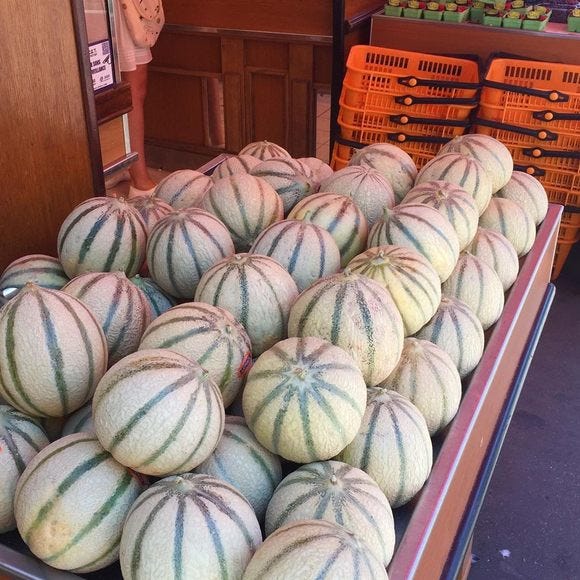
The southern summer is all about melons. François Mauriac said Bordeaux stank of slightly overripe melons. I remember a meal at Château la Prieuré in Margaux with its then owner, the larger-than-life Alexis Lichine. There were just the two of us at dinner and at least two elegant servants in uniform. They brought us lovely green-skinned, orange-fleshed Charentais melons before the promised duck. They were perfect, we both enjoyed them and Lichine shouted over his back into the kitchen ‘encore des melons!’

Melons can be filled with sweet wine, or served with raw ham. Go further south and the water-melon is king. In Rome there are mountains of them outside the central railway station. The melon quenches your thirst and its sweetness gives you renewed energy to face the heat.

When I lived in Paris in my twenties, summer or winter, the charcutier had almost all you needed. He was open until 7.30 and you just picked up dinner on your way home and ate it when you got in. You made a roulade from a thick slice of York ham and filled it with what we call Russian salad (the Russians call it ‘Olivier’ salad and the French a ‘macédoine de légumes’). There was the salade piémontaise – potatoes, tomatoes and hard-boiled eggs, or the more elaborate Niçoise. There was brawn and slices of pigs’ snouts in vinaigrette; and pâtés and terrines and the charcutier sold pork too, so if you fancied a hot element to your dinner, you could buy a chop. Charcutiers sold offal and by some quirk beef bavettes or onglets, because being meat from within the diaphragm, they too were classed as offal.
The charcutier has mostly disappeared I might add. There can’t be more than a few hundred left in the whole of France and Navarre. There is one survivor just off the rue de Rennes in Paris which is hugely chic and even on hot days there is a queue of smartly dressed people lingering outside.
Since the heat-wave began, I have looked for ways of making cold food exciting, chiefly at lunchtime, but even sometimes in the evening. Left over chicken can be enlivened with home-made mayonnaise. The Spanish butcher in Camden Town also sells French smoked chickens. If a decent baguette can be found (we do have a good, French baker in Tufnell Park), there are pâtés, but these are also going out of fashion. Melton Mowbray pork pies are a useful summer resource, if a little heavy on the gut. Iberico ham costs the earth but is lovely with a good melon. I buy a proper buffalo mozzarella at La Fromagerie and serve them with an insalata caprese: tomatoes and basil leaves. The ‘shopski’ salad is another standby. I met it in Sofia (‘shopski’ means ‘of Sofia’) where it was one of the few dishes I looked forward to on trips to Bulgaria. It resembles a Greek salad – tomatoes, feta and cucumber – but comes without the olives.
Then there are variants on the insalata tricolore. My local Lebanese shop has some good little salads and stuffed vine leaves as well as filo pastry pies filled with spinach and feta. In the evening, however, something almost always needs to be cooked, even if it is to be consumed lukewarm: a quiche, some new potatoes, a salad of green or broad beans, the latter with added strips of raw ham, olive oil and lemon juice.
And to drink? These days I envy my son his Friday-night Weizen – the perfect summer beer. In a household stubbornly reluctant to drink white wines, there has started to be a call for them. I like a rosé now and then, it is refreshing in the heat and tolerant of spice, but the others groan and I firmly believe there is not a single bottle of rosé to be found here at the moment. I have had one victory recently which has been to convince my family that red wines can be chilled a bit rather than pouring at over 25 degrees Celsius. We buy Beaujolais, and somewhere I have mislaid some Loire reds. I must find them, as the heatwave looks like lasting at least another week. A fruit-driven wine like a simple Rioja Crianza can be chilled. I even put a serious Saint Estèphe, a 2019 Château La Croix de Marbuzet in the fridge by mistake, and it was still delicious. The longer this thing lasts, the more resourceful I shall become.
Excellent post.
You're right about the Melons, I remember having Nolly Prat Ambre in the centre of a Melon in Marseillan and it was a revelation