
Maison Zwieback
Pictures from a Family Album: Jewish Vienna 1867-1938

The story is of rags to riches and from riches to rags. It begins in the town of Bonyhad, in the region of Baja, near Pécs south of Lake Balaton in Hungary, and it ends in exile in some of the farthest-flung corners of the globe: Cochabamba in the Bolivian Andes, Santa Rosa in the rain forest of El Salvador, Puerto Rico, Prescott in the mountains of Arizona, Champaign Urbana in the wheat fields of the Mid West; and in better charted locations such as Buenos Aires, Hollywood, Monte Carlo and London. The starting point is Vienna: the capital of the Austro-Hungarian Empire and the first Austrian Republic.
It is about the Zwiebacks, both in the bloodline and their various alliances. Many of the central characters in the drama have been forgotten now: the inevitable result of Austria’s decline from a European super-power to a pleasant backwater squashed between the Alps and the Hungarian puszta; but in their time they were stars. The most important figures in the tale are Ludwig Zwieback, the businessman who emerged from darkest Hungary to create the family fortune; his youngest daughter, Ella Zirner who carried on the business after his death, becoming the queen of fashion in the city; her lover, the composer Franz Schmidt, hailed at the time as the new Bruckner; ‘Uncle’ Josef Kranz, one of the richest men in the Empire; the feminist novelist Gina Kaus, who married Ella’s nephew Josef and was later ‘adopted’ by Kranz after Josef was killed in the First World War.
Gina grew up with the Freuds, became a disciple of Adler, and went on to write scripts for Hitchcock; Hans Swarowsky, who like his cousin Erhard Kranz, was a pupil of Schoenberg and was to become one of the most influential conductors of the twentieth century. And there was Fritz Wärndorfer, a patron of the arts who owned Klimt’s Pallas Athene, had his music room decorated by Charles Rennie Mackintosh and founded the Wiener Werkstätte on the model of the English Handworkers’ Guild. Wärndorfer’s niece married Ella’s son Ludwig: Franz Schmidt’s lovechild.
The Zwiebacks were Jews and Jews were the traders and middlemen of the Austrian Empire. United by family and tribe, they linked the pieces in the otherwise hardly fathomable jigsaw-puzzle of the hereditary Habsburg lands, assembled – often by prudent marriage – over the centuries in which the family had ruled from Vienna. The civil service spoke German, while the Jews communicated in Yiddish. Later, Jews who wanted to get on spoke German and Yiddish. Jews began to appear in the small Hungarian town of Bonyhad towards the end of the first half of the eighteenth century. By 1759, there were already forty-one Jewish families there. After the reforming Emperor Joseph II scrapped some of the repressive measures against them, they began to prosper. About the time when Josef Zwieback was born in 1823, Bonyhad possessed 4,709 inhabitants: 1,586 Catholics, 1,492 Protestants and 1,631 Jews and was one of the dozen largest Jewish communities in Hungary. Two others were Mako – where the Zirner family (who made two important alliances with the Zwiebacks) are thought to have originated – and Miskolc near the Tokay Hills[1], which is commemorated in the name of Minna Singer’s second husband, Joseph Miskolczy: ‘Joseph of Miskolc’.
In 1787, the Emperor Joseph II had obliged all Jews to adopt a surname and from then onwards it is possible to identify the first Zwiebacks in Bonyhad. German, Latin and Hungarian had become the languages of instruction in imperial schools and increasingly, Jews communicated in German with other merchants in the empire. During Joseph’s reign there were around 75,000 Jews in Hungary. By the time Joseph Zwieback died in the middle of the nineteenth century, that figure had grown to nearly a quarter of a million. After 1867, the Jewish community in Bonyhad went into a slight decline: the more adventurous members of it like the Zwiebacks had already set their sights on Budapest if not on Vienna.
The first identifiable Bonyhad Zwieback was a merchant named ‘Joseph’. Germans understand the word Zwieback to mean a ‘twice-baked’ rusk, but the Jewish surname derives from the Hebrew ‘tzvi,’ meaning a deer. Many members of the same family would have opted for more Germanic-sounding names such as ‘Reh’ or ‘Hirsch’.
According to his tombstone, Joseph was born in 1812 and died on the first day of Pesach in 1850. In the winter of 1848-1849 he made a shopping trip to Vienna that seems literally to have been the death of him: he returned severely ill and died soon after.[2]
From Vienna he had written to his wife Minna née Singer in Yiddish:
‘My dearest child for a hundred years![3] I must tell you that, thank God, I am well, only my heart, I am so weak that I, God forbid, pass out every half hour and am unconscious for short periods. I thank almighty God that I have Lederer with me. I have not been able to do anything more about the purchases; and with God’s help I hope to make a start tomorrow; if only dear God might have granted that you be here with me, I might be able to regain my strength more quickly. My greatest sadness is that since leaving home I have not received a single syllable from you or the children [lives] and I kiss you and the children [lives] and also our elder relatives.
‘Your eternally loving Joseph Zwiback [sic].’
The original letter is covered with stains. According to family tradition they were caused by Josef’s tears. When he died the following verses were carved in Hebrew on his headstone:
A precious spirit, lowly and humble was he
In his prime he was plucked like a fine olive tree
Like fragrant incense that passes like a cloud
Suddenly, to the heavenly heights he took his shroud.
A righteous man, upright with G-d
A kind-hearted man - aged thirty-eight
He passed away on the first night of Pesach. He was interred with honour on the second day of Pesach
In the year 5610 (1850) of the Common Era - May G-d Wipe Away the Tears from All Faces
For Joseph to have made the all-important journey to the imperial capital, is a sign that he was moving up in the world, but there is no evidence that he was a rich man. It is possible that what wealth there was derived from his wife, Wilhelmine ‘Minna’ Singer who was also from Bonyhad. It is thought she might have been the daughter of a tax-farmer.
Joseph and Minna had four children: their only daughter – Franziska or ‘Fanny’ married the bookkeeper Leopold Löwinger. Löwinger worked for the Zwiebacks while Fanny ran a clothes shop – and there were three sons: Samuel, Ludwig and Emanuel. After Joseph’s premature death, Minna married Moritz Miskolczy. At first, she went to live with her new husband in Békés, another very Jewish town south of the puszta, and had two more children: Josef and Grete. Later she moved to Vienna, where her entire family had gone before her. She lived to the age of eighty-four, dying on 28 July 1906, outliving her middle son Ludwig Zwieback by several months.
Joseph and Minna’s eldest son, Samuel, was born in Pécs on 28 April 1843. He served as an NCO in the Hungarian Army at the Battle of Königgrätz against the Prussians in the Austro-Prussian War of 1866 and was badly wounded during the deft retreat performed by Field Marshal Benedek following the Prussian victory. His brothers’ children referred to him as ‘Onkel Ausgerückt’ or ‘Uncle Retreated’. Samuel’s brother Ludwig was only thirteen months younger than him, born on 25 May 1844. The youngest, Emanuel, was his junior by four years. The Battle of Königgrätz that blooded Samuel, brought unforeseen benefits to the Zwiebacks: the defeat led to the creation of the Dual Monarchy which put Hungary on an equal footing with Austria and Jews were freedom to settle anywhere in Vienna. The Zwiebacks seized the opportunity with both hands and in 1872 opened a ‘bazaar’ in the imperial capital called Erste Mariahilfer Manufactur-Consumhalle. They were to go on to found two department stores based on their original trade as cloth merchants, with subsidiaries in Budapest, Graz and Salzburg.
The more down-market version was founded first as the Ludwig Zwieback & Bruder, ‘Kaufhaus Zwieback’ or Zwieback Emporium. Zwieback’s was across the road at 111 Mariahilfer Strasse, Vienna’s great commercial boulevard. It was revamped in 1910, when designs were made by the Wiener Werkstätte designer Dagobert Peche for some attractive stained glass for the new doors. Zwieback’s rapidly achieved the reputation of being the place to find a good deal: even when it was on its last legs in the 1920s, the spring collection announced attractive bargains in the form of ladies’ fashions and cloth. The building is still there, although, like Modehaus Zwieback in the Kärntnerstrasse, the first two floors have been altered beyond recognition. Naturally, the big ‘Zwieback’ sign has been taken away. It stretched round the three corner bays that joined the Mariahilfer Strasse and the Webgasse. What remains is the eagle on the roof. This was a double-headed eagle, signifying the Zwieback’s position as purveyors to the court. One of the heads, however, is missing. It can be assumed that it was struck off after the emperor’s abdication in 1918.
With time, Mariahilferstrasse 111 became the province of Samuel and Emanuel when Ludwig went his own way and opened a luxury version in the centre of the city called ‘Ludwig Zwieback & Brüder Co’ in 1897. Later this became the ‘Modehaus’, ‘House of Fashion’, ‘Maison Zwieback’ or simply ‘Palais Zwieback.’ The new luxury department store aroused the fury of Vienna’s leading antisemite, Georg von Schönerer, the ‘Knight of Rosenau’, who accused Zwieback of abusing his workers and undercutting honest artisans. The Jewish press rose up to take Zwieback’s side in the spat. The new Zwieback’s was located first in the magnificent Palais Equitable opposite the cathedral until it moved to its permanent address on the corner of the Kärntnerstrasse and the Weihburggasse. That the Kärntnerstrasse premises was meant to be a cut above the old shop was clear from the publicity: advertisements printed in French described the shop as a ‘maison de première ordre’ and sales of cloth gave way to haute couture.
Ludwig Zwieback’s new building was designed by Friedrich Schoen, who was like Ludwig Hungarian-born and it was ready for Zwieback to move in with his stock in 1897.[i] It was later refitted in Jugendstil by Friedrich Ohmann, the architect of the beautiful Kursaal in Merano. By that time Ludwig was dead and Ella Zirner commissioned the new architect, whose work is still prominent in Vienna, notably in the monument of the Empress Elisabeth (‘Sissy’) in the Burggarten and in the decorative architecture erected along the River Wien as it crosses the Stadtpark. Ohmann was favoured by the Zwieback family. Even after the First World War he was brought in to design the new tea room. He was also responsible for ‘Onkel Josef’ Kranz’s Palais in the Liechtensteinstrasse.

Ohmann’s embellishments for the Wien River in the Stadtpark
Zwieback’s central feature was an oval staircase which took customers up to the three floors of showrooms and down one to the basement. There were individual salons where ladies might try on the creations, a reading room and a refreshments room and so-called ‘dark room’ where you could try out your costume by an evening light. The seamstresses who knocked up Ludwig and later Ella’s creations were lodged under the eaves and there were studios at the top that enjoyed plenty of light. Ohmann added the glazed awning above the beautiful main door, surmounted by a double-headed eagle with the monogram ‘FJ’ for Franz-Joseph: announcing the fact the Zwiebacks remained official purveyors to the court in their newest venture
Ludwig must have been noticed at the Russian court as well, as he was a ‘knight’ of the Order of St Anna by the time of his death. The non-Christian version is that bearing the Russian imperial eagle. Recipients were awarded ‘personal’ nobility.
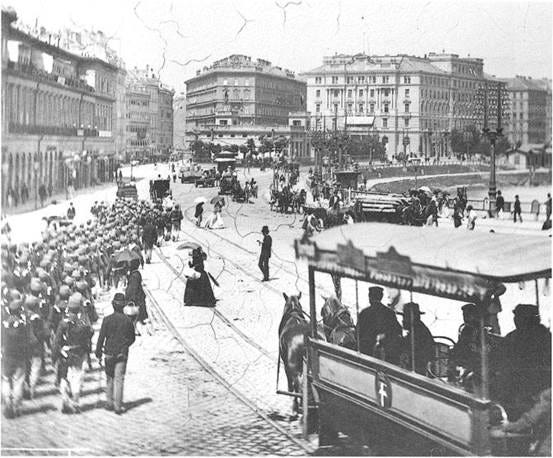
The Morzinplatz as it was with the Hotel Metropol in the background. This photograph was taken before the erection of the neo-baroque building that was Ludwig Zwieback’s last home.
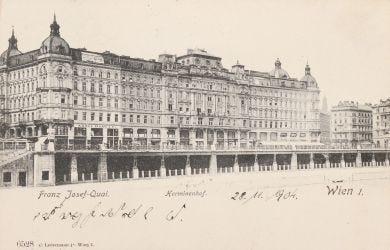
Ludwig Zweiback lived in this building on the Morzinplatz. It was destroyed in the Second World War. The Hotel Metropol is on the right.
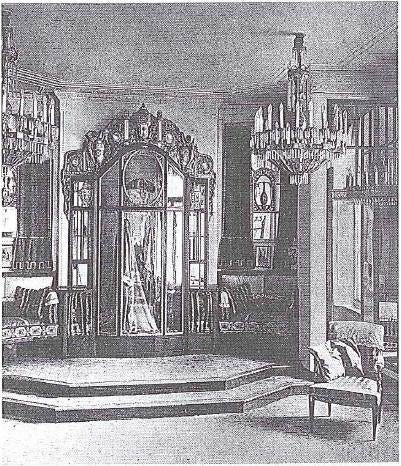
Interior of the Modehaus Zwieback after Ohmann’s new design
Friedrich Ohmann’s entrance to the Kärntnerstrasse. Note the double-headed eagle: the Zwieback were purveyors to the court.
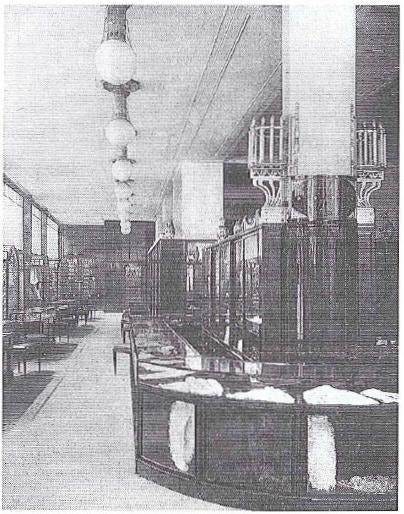
An interior
The door was flanked by display windows framed by multicoloured marble and under the marble was written ‘Zwieback’ on a gold-plated panel. Either side of the door were black marble figurines. Ohmann made much use of electric lights, with hanging lamps on the ground floor exterior and candelabra on the balconies of the third floor. His interiors also show a profusion of glass and he appears to have provided a dramatic new staircase flanked by crouching nymphs. On the first landing was a lift surmounted by a portrait bust of Ludwig Zwieback.[4] Despite ‘aryanisation’ by the Nazis, photographs show the Zwieback name all over the façade in 1939. One picture reveals people reading the notices in the windows of the empty shop. The signs on the shop are still mostly in French.[5] At their height, the Zwieback Brothers had their flagship in the Kärntnerstrasse together with three branches in the Mariahilferstrasse, another in Graz and a sixth in Budapest.
Ludwig married Katharina Singer of Apatin in Vukovar (in present day Croatia). Katharina did not go to Vienna with Ludwig at first. Her first child, Gisela, was born in the small town of Mezőberény, about ten kilometers north-west of Békés, and not far from her native Apatin.
Katharina died at the age of thirty-three on 23 November 1878 soon after giving birth to their third daughter Ella. At the time Ludwig was living at VI, Webgasse 39 just round the corner from the shop at Mariahilferstrasse 111. They had four children: a son Josef, born in 1870, who was drowned aged nineteen while boating in Neumarkt in Styria, his elder sister Gisela – born 7 April 1869, Malvine (later ‘Malvida’) – born 11 April 1873 – and Ella.
At first all three brothers ran the Mariahilferstrasse emporium together, but then Ludwig set his sights on something more grandiose and moved to the Kärntnerstrasse in the city centre. After the deaths of the other brothers, Samuel’s sons Josef and Siegfried administered the Mariahilferstrasse branches. Josef’s widow and unmarried daughter, the piano teacher Mary, were both slaughtered by the Nazis in Lodz Ghetto. Siegfried married a Christian woman called Johanna Nepomucki who concealed him from the Nazis during the Second World War.
Ludwig’s creation, the Modehaus or ‘Maison’ Zwieback was one of the best-known shops in Vienna until it ceased trading in 1938. Ludwig, who was the sole director of the Kärntnerstrasse department store, was made a ‘Kommerzialrat’ or ‘commercial counsellor’ as well as being appointed purveyor to the imperial court. He did not only display his nous when it came to seizing the possibilities offered by the top end of the haute couture market, he also bought the neoclassical Palais Arnstein-Pereira[ii]. The Palais had housed the Viennese Stock Exchange between 1812 and 1855. It had originally been owned by the Colloredo family but was reconstructed between 1840 and 1842 to plans by Ludwig Förster. From 1842, it was also the offices of the trading house of Pereira-Arnstein. The barons Pereira were heirs to the Arnsteins, the first Jews to be ennobled in the Austrian Empire, and famously patrons of Mozart at their Palais in the Graben. The Berlin-born Fanny Arnstein was Vienna’s most celebrated Jewish salonnière at the time of the Congress of Vienna.
The building was a ‘Mietshaus’ divided up into a number of apartments, and never intended to form a single residence. Ludwig must have perceived its purchase as a good investment. Later the restaurant ‘Zum Weißen Rauchfangkehrer’ occupied part of the ground floor, its interior has remained virtually unchanged since 1937.[6] In the old stables between the Palais and Modehaus Zwieback was the tea room of the department store. From 1933 this became the restaurant ‘Zu den drei Husaren.’ Some time after Ella’s birth, Ludwig moved to Morzinplatz 5 where he died of a heart attack at the age of sixty-one on 22 January 1906. In his will, he left the running of the Kärntnerstrasse business to Ella and her husband, Alexander Zirner. Naturally the will, which favoured one daughter above the other two, was ‘highly contested.’[iii]
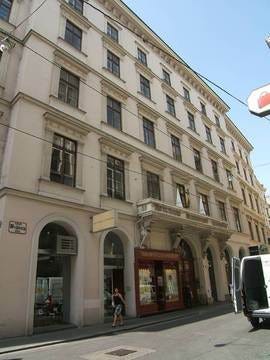
The Palais Arnstein in the Weihburggasse.
Once he saw that there was money to be made, Moritz’s son Josef Miskolczy joined his half-brothers in Vienna. At first, he dealt in textiles and tailors’ equipment before hitting on the idea of manufacturing rubber sweat-guards for ladies to supply outfitters like his half-brothers. This led him to start a rubber-processing factory at Traiskirchen south of Vienna. This later formed the core of ‘Semperit’: one of Europe’s largest tyre-makers until its closure in 2010. Ludwig Zwieback was an investor in Semperit. When he died, Ludwig’s daughters insisted the money be paid back, with the result that Josef Miskolczy was obliged to sell the firm.
Ludwig Zwieback’s will makes instructive reading. He left the sum of 2,173,545.54 crowns. After his debts and the smaller annuities had been paid, the girls received roughly a third each of 1,324,887.09 crowns. Ella and her husband Alexander Zirner had been involved in Ludwig’s business since their marriage, and as the will states, they showed the greatest capacity to continue in the work. Ludwig’s preference for Ella was also clear in that she received twenty percent more than the other girls, and the remaining eighty percent was to be split three ways. This was contested by the other sisters, but in the end, Malvine decided just to take her portion. Gisela remained a ‘silent partner’ in the firm.
The will ordained that the firm could not be dissolved except if all three daughters were in agreement: therefore, all three Zwieback girls remained owners of the company. Half of what they received was to be passed on to their children. The girls were amply funded by the standards of the time: they were very rich, but the other over forty percent is interesting too, as it demonstrates a respect for his nuclear family as well as his generosity towards charities – not all of them Jewish.
There were a great many smaller legacies in the will. His mother (who outlived him by a few months) was to receive an annuity of 3,000 crowns.[7] There was also a yearly income of 2,400 crowns for his cousin Charlotte Graner, who had lived in his house as governess to the children. She must have played an important role in the household: the children lost their mother at nine, eight, five and nought respectively.
The will sheds only a little light on Ludwig’s relationship with his brothers. Ludwig left nothing for Samuel. He justified this by writing ‘his material conditions are such, thank heaven, that I do not need to be concerned.’ Emanuel was already dead. Ludwig mentions that he has left provision for Samuel’s sons Josef and Siegfried, presumably by bequeathing them sole responsibility for 111 Mariahilferstrasse. Like his daughters, he also believed that Josef Miskolczy was adequately compensated by the investments he had made in his factory and that ‘by a rational administration of the company he should receive a respectable income.’ He left a yearly sum of 1,200 crowns for his sister Fanny Löwinger, his brother-in-law Josef Greif and his sister Bertha, if they were not in a position to maintain their son Arnold. Arnold Greif married his cousin Grete Miskolczy. Both perished in Auschwitz. In his will, Ludwig wanted his nephew Friedrich ‘Fritz’ Squarenina to continue as chief of staff at Ludwig Zwieback & Cie. He eventually left the firm and started another fashion house in the Kärntnerstrasse with a capital of 1,000,000 crowns. We are told that his customers included many members of the nobility.[iv] The business suffered after the First World War, but a gentleman’s branch was opened later. The shop prospered during Fritz’s lifetime, but Squarenina’s son was not up to the task of continuing after his father’s death.[v]
Otherwise, unexplained is Gabrielle Mareck of 1, Vorlaufstrasse, who showed Ludwig ‘dedication and love’. In gratitude Ludwig left her a furnished house in Sankt Gilgen on the Wolfgangsee in the Salzkammergut. It seems probable that Gabrielle was Ludwig’s mistress. His wife had died twenty-eight years before him. Gabrielle was also to receive 20,000 crowns in cash together with a position in the firm paying no less than 300 crowns a month. The sum of 20,000 crowns was also placed in the savings account of Leopold Menhart, who had worked for Ludwig for a number of years. There is a website claiming that a Leopold Menhart, born 5 June 1871 who died in a Nazi camp, left money in a Swiss bank account that was never reclaimed. It is most likely that this is the same Leopold Menhart and that this money was grown from the sum bequeathed to him by Ludwig. His heirs were to continue paying pensions to cousins Benjamin Singer and Betty Halpern.
Another 20,000 was to be invested to deal with eventualities resulting from his unsuccessful relations who could make claims on Ludwig’s posthumous support to the tune of 100 crowns a time. Ludwig had not forgotten his sons-in-law: the lawyer Sigmund Kranz received 5,000 crowns for overseeing the will, while Max Zirner was appointed executer. Ludwig shows that he was an enlightened employer before the time of fixed state pensions. Anyone who had worked for the company for fifteen years was to receive fifteen percent of his salary as an annual pension. Smaller sums were left to the Viennese voluntary ambulance men and 300 for each of the following Jewish charities: the Institute for the blind, the Institute for the Deaf, the Association for Poor Jewish Convalescents, the Association for Jewish Women in Labour, the Association to Support Poor Tradesmen in Need and the Association to Support Poor Jewish Students. He left 1,000 crowns for the relief of the poor of all religions in the three Bezirke of Innere Stadt, Mariahilf and Neubau. He wished to be remembered by his brothers-in-law Samuel and Albert Singer in Budapest, but they received no bequest.
The Second Generation: The Zwieback Girls: Gisela, Malwine and Ella.
By the time the patriarch died, the three Zwieback girls had all made decent marriages to prosperous Jews who moved in the same sort of world as Ludwig. The eldest, Gisela, had found or been pushed towards Marton ‘Max’ Zirner (1857-1918). They married on 10 March 1889. Max also came from Bonyhad in Hungary and was to become the proprietor of a jewellery business in the Graben that was also a purveyor to the imperial court. At the end of the eighteenth century, the founding father of the Zirner line built a large house in Bonyhad. In 1899, ‘despite weather and rain, despite war, revolution and national bankruptcy, it [was] still there in its full purity and glory.’[vi] The founder’s name was Jakob ‘Hirsch’, so it is to be assumed that one of his daughters married a Zirner and that the ‘Hirsch’ was a Zwieback?. ‘Max’ was Hirsch’s great-great grandson, the eldest son of Markus (1829-1906), the first of the family to be appointed Imperial court jeweller, and his wife Franziska Löwy (1835-1911). Markus and Fanny had nine children: Max, Hermann Julius, Sigmund, Julius, Alexander, Moritz (or Morris), Marie (married Dr Viktor Fürst), Irene (who married Alexander Koch) and Gisela (married Dr Jonas Braun). The six boys carried on the jewellery business, with Sigmund remaining in Budapest. The girls made wise marriages: two out of three of them to Viennese lawyers. Max’s prospects must have looked good: Markus also continued in business in Budapest and it is probable that he only moved to Vienna in the late eighties, when Ludwig Zwieback’s daughter was of an age to marry.
Court Jeweller Markus died at 13 Weissgasse 19 on 21 July 1906 at the age of seventy-seven, leaving a will written in 1894 in which he told his six sons to forget their differences and work together. This doesn’t seem to have been the case. Markus is first registered as a jeweller, gold and silversmith in Vienna in 1888. His son Max started the firm of ‘Brüder Zirner’ in 1884 together with his brother Hermann Julius. In 1891, Max took over Markus’s business at Graben 18, which he ran as a branch of his father’s shop until 1896. In 1893, Max and Hermann Julius parted company and from then onwards Max operated on his own. Alexander and Julius Jakob formed J & A Zirner. Several members of the family operated a studio at Kärntnerstrasse 42 where Markus had a business and they also had a branch in the Alte Wiese in the exclusive spa town of Carlsbad. Alexander was at Kärntnerstrasse 51 in 1897, but in 1899 left and became involved in running the Modehaus Zwieback. Moritz (born 28 July 1864) emigrated to the United States on 3 October 1894 and presumably ran a shop there until the First World War. He had been permanently resident in New York from 1886 to 1892. Moritz’s hallmark differed from Max’s having a slight triangular indentation in the centre top and bottom, He was active in the Kopernikusgasse and the Gumpendorferstrasse in the Sixth district from 1899 to 1903, and the Wienstrasse in the Fifth in 1908.
It is not clear whether it was Markus or his father who started the jewellery business back in Hungary in 1855. Markus was clearly successful, and lived at Schwindgasse 18, just behind the Karlskirche, and a long way from any part of Vienna associated with poor Jews. It was a double-fronted house with a ‘palatial neo-renaissance façade’ by the architects Claus and Gross.[vii] The Zirners were possibly the first people to live in the new mansion block in the vicinity of the Belvedere Palace. It was Moritz who caused his father the most grief in that he refused to abide by the family firm. Moritz’s absences from family feasts also troubled his father. He was accident-prone, had once been precipitated down a steep ravine and his life only saved by a handy tree. On another occasion he was riding through Doboy in Bosnia when his carriage tipped over into a ditch and he was only saved from serious hurt by a thick sheep or wolfskin coat.[viii]
Max was the most prominent of the boys. He qualified in 1884 and died on 16 June 1918 at the age of sixty, possibly weakened by the Spanish flu epidemic that year. He had a shop at Graben 18 from 1885 to 1896. In 1898 he is recorded as trading from Kärntnerstrasse 20 where his window decorations were one of the sights of Vienna. That year, he had established himself at his longest-lasting and most prestigious address: Graben 7 (and Seilergasse 3). He is listed as the sole proprietor in 1914, with a staff of four. Although there were temporary staff like Alphons Barb, who worked for the firm to pay his way through Vienna University. The mighty stone building that housed Brüder Zirner is still there, a short distance from the cathedral across the Stock-im-Eisen-Platz. It was by the architect Julius Mayreder and built between 1895 and 1896, suggesting that Max Zirner had commissioned the building himself. Dehio describes it as a ‘late classical dwelling with its original shops’ at ground floor level. Until comparatively recently some of the original fenestration survived in the Seilergasse with volutes and acanthus leaves separating the glazing bars. Inside the marble, mirror domes and stucco decoration is preserved in the stairwell. A section of the original fenestration
Brüder Zirner on the Graben
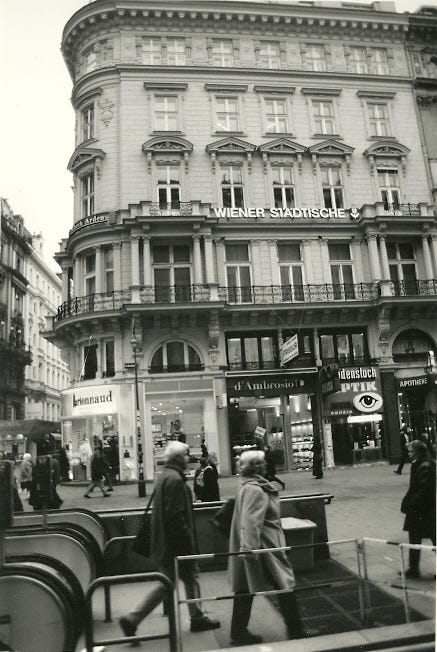
Brüder Zirner
There were branches of Brüder Zirner in the Friedrichstrasse in Berlin, Váczi Utca 26 in Budapest[8]; and in season at the ‘Zwei Störche’ in the Alte Wiese in Carlsbad (possibly the same premises as J & A Zirner). Max was listed in Lehmann’s directory for 1896-1899 for his large choice of gems and jewellery, silverware, silver services, tea services and coffee services, cutlery, girandoles, children’s cutlery, beakers and table decorations.[ix] Max was a respected businessman, and was not only the court jeweller, but an official purveyor to the court and the emperor’s personal supplier. He was also court jeweller to the Shah of Persia and one of the best-known jewellers in the Austro-Hungarian Empire. When he died, he left his sole heir, Gisela, around 3,500,000 crowns. Besides serving on the board of the Jewish community, he was an honorary member of the Viennese Women’s Union for the Protection of Poor Orphans. He took over his father’s business, but instead of living in a palatial building in the centre of the city he chose a family villa at Neue Weltgasse 9 in Hietzing, close to the emperor’s summer palace at Schönbrunn. It was conveniently located, being just across the road from the Hietzing synagogue, and it is safe to assume that the Zirners were not the only Jews in the neighbourhood. The synagogue was destroyed by Nazi Party members on 10 November 1938: Reichskristallnacht. The Zirners also had a country house on the Wolfgangsee, but they only went there in the summer, taking with them their cook and a chambermaid.
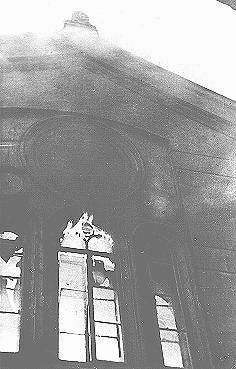
The Synagogue in the Neue Weltgasse in 1938
In Gina Kaus’ novel, Die Schwestern Kleh there is a description of a fashionable, old-established jewellers’ shop based on Brüder Zirner. She paints a portrait of Herr Kleh’s workplace: ‘a narrow office next to the actual jeweller’s shop. It was sacred: no one, not even the children, could enter without permission… It was here, with a magnifying-glass under his eye and a little pair of scales in his hand, that Herr Kleh examined the pearls and coloured stones that he bought in such profusion; here that with the drawings made by his goldsmith, he assembled his individual decorative creations. Every so often, when a client or a supplier entered the shop, he had to drop everything, as he wanted to take sole responsibility for the fact that nothing wandered from its place.’[x] After Max’s death, the jewellery business was run by his wife, who proved that her father had been right in thinking that Ella alone was capable of running a company. Gisela took over the reins ‘after the death of Papa Zirner in 1920 (sic) and I believe not very well. She was not capable of dealing with the inflation and had sold the car and had dismissed all her servants bar two.’
Max’s sister Gisela[9] or ‘Gisi’ remained close to the family despite being twenty years her brother’s junior. She married the lawyer Jonas Braun and had two sons: Otto and Robert. Otto became an archaeologist specialising in pre-Columbian art and moved to Bolivia in the nineteen-twenties from whence he sent his mother valuable artefacts which found their way into the Volkerkundemuseum or Museum of Ethnology during the Third Reich. Otto’s presence in Bolivia in 1938 almost certainly inspired Felix Zirner to emigrate to the remote Andean republic. He travelled there with his aunt Gisi who later went on to Argentina and settled in Buenos Aires.
Gisela died of a stroke in 1930 at Hietzinger Hauptstrasse 52, just round the corner from the Villa Zirner which had been sold as a result of the collapse of the Bodencreditanstalt Bank in 1929 and untimely demands of her son-in-law Rudolf Rapaport to deliver Kati’s dowry in full after her death. It was not her first stroke. Her speech was already impaired and for a while she retreated to the south of France. As there was no more money, Brüder Zirner had to be sold. According to the Grundbuch the Villa Zirner was heavily mortgaged. It may well be that Gisela was badly in debt and that the firm and property needed to be sold to satisfy many creditors, not just Rapaport.
Ludwig’s second daughter Malwine had chosen to marry the court lawyer Sigmund Kranz (a rich Polish Jew); and Ella Max Zirner’s brother Alexander, originally another jeweller who was to run Modehaus Zwieback until his death in 1924. Alexander was also on the board of the Jewish ‘Kultusgemeinde’ or community, the family was certainly religiously observant but in their dealings with the wider world, they counted as assimilated Jews. That meant they went to the opera, concerts and the theatre and brought their children up to enter the professions. It was only a short step to baptism, and Malwine and her family converted en masse in 1904.
We are lucky to possess Gina Kaus’s intimate account of Gisela. Gina lived with the Zirners after their eldest son Josef or ‘Pepi’ joined the K & K (or ‘Imperial and Royal’) army in 1914. According to Gina, Gisela was known as ‘the Old Hen’. In her description she is not without culture. She was born in Hungary and, like her husband, spent her first years in ‘Transleithania’: the half of the Habsburg Empire that was administered from Budapest. It is probable that she spoke Hungarian and that Hungarian continued as a family language into the next generation. Certainly, Felix Zirner’s friend the archaeologist Alphons Barb spoke Hungarian to his children and even imparted a smattering of the language to his grandchildren.[xi]
[1] The Jews took over from the Greeks as the chief traders in the highly prized wines of Tokay close to Miskolc, and most of the villages in the wine region have imposing synagogues.
[2] He was thirty-eight, the same age as his great-grandson Felix when he died in Bolivia in 1943.
[3] (Kinderleben bis hundert Jahre – literally ‘Childlife for a hundred years’)
[4] This has vanished.
[5] Modehaus Zwieback is now a branch of Apple. Ohmann’s work has been ripped out except in the recently restored tea-room/café – the former Zu den drei Husaren restaurant. From the first floor up some of Schoen’s is still visible.
[6] Although a stuffed bear cub holding a clock at the end of what looked like a fishing rod, present in the early nineties, has disappeared in the course of a recent restoration. It is not known whether the bear had become too moth-eaten, or that it was now considered in poor taste. It is illustrated in Giles MacDonogh, The Food and Wine of Austria, London, 1992, 112.
[7] An indication that 3,000 crowns was a decent annual income, and that a millionaire must be considered very rich indeed.
[8] Now the Hungarian headquarters of the drinks giant Diageo.
[9] Like Marton, Gisela is a stock Hungarian name.
[i] Günther Buchinger, Gerd Pichler et al, Wien I. Bezirk – Innere Stadt, Vienna, 2007, 743 (hereafter ‘Dehio I’)
[ii] Georg Dützele von Coeckelberghe and Anton Köhler eds, Curiositäten und Memorabilien-Lexikon von Wien 1, Vienna 1846, 235, quoted in Richard Kurdiovsky, Die Erbauung des Palais im Spiegel der Familiengeschichte, in Klaus-Peter Högel and Richar Kurdiovsky eds, Das Palais Coburg: Kunst und Kulturgeschichte eines Wiener Adelspalastes zwischen Renaissance Befestigung und Ringstraßenära, Vienna 2003, 72-73; Dehio, I, 891-892.
[iii] The words are those of Georg Gaugusch, who read the will. I am also indebted to Gaugusch, IV, 5335-5337 and 5356-5361
.
[iv] ‘Personalien’, notes on the Zwieback family written by Hanns-Walter Lange, London, 1980.
[v] Lange, Personalien.
[vi] ‘Die Rede unseres lieben Vaters [Markus Zirner] gehalten 8 März 1899.’ Document in possession of Esperanza Zirner.
[vii] Wolfgang Czerny et al, Wien II. Bis IX und XX. Bezirk, Vienna 1993 (afterwards ‘Dehio II’), 196.
[viii] ‘Die Rede unseres lieben Vaters [Markus Zirner] gehalten 8 März 1899.’ Document in possession of Esperanza Zirner.
[ix] Waltraud Neuwirth, Lexikon Wiener Gold- und Silberschmiede und ihre Punze 1867-1922, Vienna 1977.
[x] Gina Kaus, Die Schwestern Kleh, Amsterdam 1934, 34.
[xi] Information from Jennifer Barb.