
Two Books
The Strange Death of Central Europe and a Broad Take on Strategy

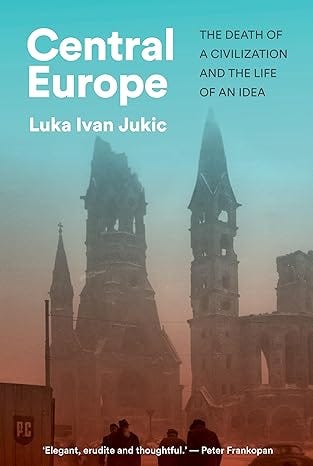
There have been major changes to the way history is written in my lifetime. When I was a history student many books were dedicated to political history and limited by political geography. Nowadays, the main themes are race and gender, together with micro-histories that probably originated in dissertations but which make important contributions to original knowledge by providing a sharp focus on time and place. What one often misses, however, is a broad, sweeping narrative. Luka Ivan Jukic provides just that in his Central Europe: The Death of a Civilisation and the Life of an Idea which comes as a welcome return to an approach more familiar a generation back.
Or is it? Most scholars then remained very much anchored in a geographical entity dictated at least partly by their own linguistic limitations. Historians of Germany were just that, they were not historians of Austria (although the language was the same), Poland, Bohemia or the Balkans. Historians of Austria didn’t write about Germany, nor did historians of Poland, Czechoslovakia or Yugoslavia (although I know one historian of Germany who was launched into print by the fact he had been enlisted as an assistant to a prominent historian of Poland to read relevant German texts). Jukic, it seems has none of these problems: he appears to command all the languages he needs for his broad sweep and to be able to write it up in a commendably elegant English.
Jukic examines Central Europe from the coronation of the penultimate Holy Roman Emperor Leopold II, in Frankfurt in 1790, to the present day. His study encompasses the constituent states of the Empire (including the quasi-independent Prussia, Bavaria, Saxony and Hanover) plus those (such as Hungary, Poland and the Balkans) which lay outside it, but were very largely controlled by the states of the Holy Roman Empire.
‘Central Europe’ is the land in between the ancient civilisations of Southern Europe and the enlightened states of France and Britain to the west and north. To the east lies the vast mass of Russia, to many the very personification of barbarism. Shortly after Leopold’s death in 1792, a Central European army was defeated by a French Revolutionary levée en masse at Valmy and for the next twenty-three years French armies swarmed over Central Europe. The result was a growth of malignant nationalism, breeding a worm that was to completely destroy the culture of that loose assembly of lands between the Rhine and the Bug.
At first, Central Europe had looked to France to inspire its culture and later, to some extent Britain. Those who aspired to nobility or culture spoke French. Frederick the Great belittled German, and French scholars were employed at his court to polish up his French verses. Nationalism turned Central Europeans in on themselves, first languages and later races were ranked in order of nobility. As far as Central Europe was concerned, German with its educated middle-class aspired to first place with the various Slavic languages settling at the bottom of the pyramid.
When the same attitudes were applied to race, and particularly after the development of evolutionary theory, the seeds were sown for the racialism that would end up by destroying Central Europe as a cultural idea. If Slavs were considered inferior, Central Europe’s increasingly emancipated and alarmingly successful Jewish population fared worse. The consequences are well known, particularly in Germany and Austria, but possibly readers will be less familiar with similar tendencies in Hungary, Poland or Romania. When the edifice collapsed in 1945, much of the ruins fell ironically to Slavic Soviet Russia. Jukic provides some hope that a new Central Europe might have begun to see the light after 1989, but there is little sign that racial prejudice is on the wane.
In Sir Lawrence Freedman’s On Strategy and Strategists. Collected Essays 2014 – 2024, the former Professor of War Studies at King’s College London reveals just how much the word ‘strategy’ has broadened its usage from its original sense (στρᾰτᾱγός means a general – so ‘strategy’ is the ‘art of the general’) in recent years to the degree that it might be as much in use in business as it is in military commands. Freedman cut his teeth on nuclear deterrents during the Cold War, studying under the late Sir Michael Howard, the subject of an affectionate essay here. It was a pleasure to read about Michael. I had the good fortune to have three spirited conversations with him in my life, the first over a course at a formal dinner at All Souls, where he complained sniffily about the inelegance of modern undergraduates; the second at the Reform Club, where he enthused over my biography of Frederick the Great until I reminded him that he had given it a very extensive, bad review (which made him chuckle); and finally at Garsington, where he insisted on introducing me to his long-established lover, Mark James – which I took as a sign of acceptance. He had forgiven me for short-changing him on battles in my book on Old Fritz.

The collection comes into its own with the Iraq War (Freedman served on the Chilcot Enquiry) and the role of Tony Blair and his famous ‘WMDs’ (which Blair did actually believe existed, even if they were more likely to have been chemical or biological than nuclear) and the Russo-Ukrainian War with Putin’s ‘fanatical’ strategy and its major shortcomings. Putin’s aims, however, seem clear enough. What I missed was an appraisal of the current war in the Middle-East, but Freedman can’t be blamed for that. Books take months to produce, and this war is only a few weeks old. Netanyahu’s strategy seems clear enough, but Trump’s appears all over the place and may yet end up being his worst mistake to date. Trump says he acts on instinct, that he feels something ‘in his bones’ which is not far from Hitler’s famous ‘Fingerspitzengefühl’ but what he is expecting to get out of this campaign is not so clear. It may be that he just wants to win the Mid-terms, but as matters stand, he may have already lost them.
Thank you.
I’ve got Central Europe on the to be read pile. Good review.