
Woolverstone Hall
The Best Days of my Life? (from 18 May 2020)

In these pandemic times, I watch a film most nights. A few weeks back it was Tom Brown’s Schooldays in the 1951 version with John Howard Davies as Brown (the famous Oliver in Oliver Twist) and a very sober and moving Robert Newton as Dr. Arnold. Michael Hordern appears as a traditional, flog-‘em-all master and a young Max Bygraves delivers a few lines as a coachman.
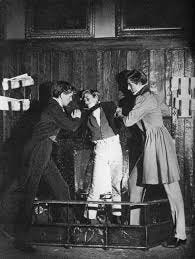
About a decade ago my daughter and I watched the 2005 television film of Tom Brown with Stephen Fry playing Arnold. She was appalled. About twelve at the time, she couldn’t believe that any school would ever have been like that: so bleak, so vile and so violent. For me, however, nothing was remotely shocking; indeed, I may not have travelled up to Rugby with Max Bygraves in a coach and six (we took the motor coach from County Hall) but in virtually every other aspect school life had remained unchanged in the intervening 130 years. My first two years of secondary school were nasty, brutish and - hallelujah - short!
And my schooling was in no way grand. My mother left my father when I was three. My elder siblings were both in private institutions then; my brother in the junior school at Highgate, my sister in a pre-prep in the Brompton Road. I was making merry with the Servites in the Fulham Road nearby, but they both had to be taken out and packed off to Bousfield Primary School in the Old Brompton Road, where I too went in due course. Two years later my brother needed a secondary school and my mother was told about Woolverstone Hall near Ipswich in Suffolk.
Woolverstone was a single-sex grammar school spread over fifty acres of parkland and around a Palladian mansion rising serenely above the River Orwell. There were 360-odd (verb sap) boys apportioned to six houses. Modelled on a traditional public school, it was founded by the Inner London Education Authority in 1951. It was a revolutionary idea: richer parents paid modest fees, the poorer ones, none. The children came from broken homes like mine or from deprived parts of the city and were thrown in with a lot of NCOs’ boys. Mens sana in corpore sano might have been the motto, as there was sport, sport and more sport. Academic standards were nonetheless high with as many as half a dozen boys going on to Cambridge every year.
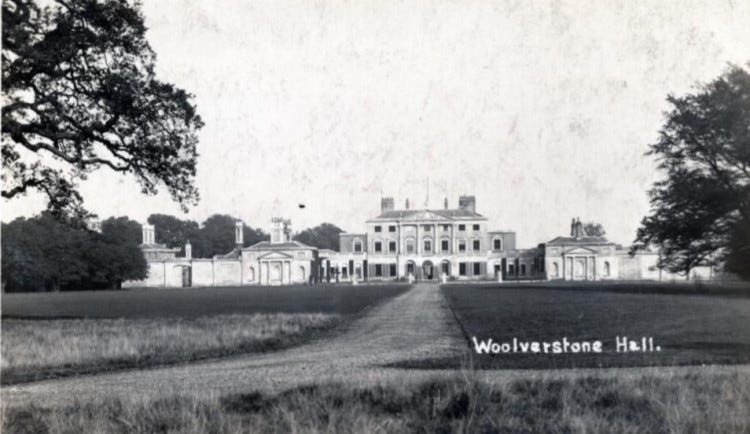
Six years later it was my turn. I passed the Eleven Plus and joined my brother at Woolverstone. He was already in the second-year-sixth. I was put in his house but he was a remote, god-like figure and both he and his study-mate Hotz de Baar were to go on to Cambridge, as indeed was our head of house: the actor Mark Wing-Davey. Wing-Davey actually won a scholarship to Caius, a thing so rare that the whole school was granted a half-holiday to celebrate. If Wing-Davey had not been a god before, he was then. We all knew his best friend too: a slight boy with flashing spectacles called Ian McEwan.
The houses were named after their first housemasters. Ours, however, was called Orwell after the river, not the writer. It was said the first housemaster’s name was Mudd, and that for obvious reasons they had declined to call it Mudd House. He was succeeded by a pyknic named Thornberry. We called him ‘Stumpy’.
Stumpy didn’t like my brother. He had nicknamed him ‘Rubbish’. When he appeared in a Grenadier Guards’ tunic (remember Sergeant Pepper?) at the leavers’ dinner Stumpy humiliated him before the entire house, telling him to go back and change. In his eulogy he damned him with the faintest praise: ‘the best timpanist the house has ever had’. He failed to mention his conditional place to read Natural Sciences at Cambridge.
He was a brutal little chap who smelled of sweet sherry and was rumoured to be romantically linked to the housemaster in the neighbouring house. I am not sure that was true. I never saw any masters taking a sexual interest in us but we were forever groping one another. The prettier boys had to pretend to be girls and were subjected to squeezing and petting. Kissing, however, was quite taboo. A tall, freckly farmer’s daughter used to come to see some of us by the ha-ha. We jumped on her. She ran away, cross and bruised, but always came back for more.
Stumpy was inclined to sadism. One day he performed a prodigious feat by beating four entire forms. A turd had been found on our lavatory floor. Anyone could see the thing had been dropped from above, in fact from ceiling height and over the partition from the third and fourth-form bogs adjacent to ours. There was a gap above the cubicles and plenty of room for someone to lob a turd.
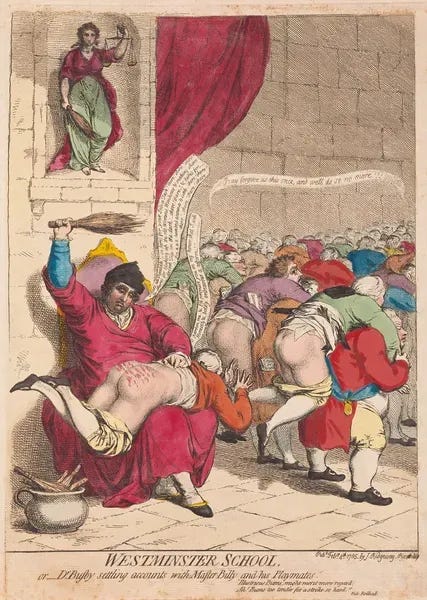
We were formed up in a queue on the stairs in our dressing gowns. It was all a bit like an updated picture of Dr. Busby beating the entire school at Westminster, except this was Woolverstone, not Westminster. We had to drop our pyjama-bottoms and gratefully receive our punishment, remembering to thank Stumpy for being kind enough to cane us before we returned to our beds.
Our chief bugbears were the second formers with whom we shared our dorm. We were on the bottom bunks with them on top. In the showers, heads were divided into first and second year, according to efficiency: if the water came out in a dribble, they were for the new boys. One day a much put-upon second-former with big ears called Andy Gus found me under a second form nozzle. He beat me bloody and I had to be admitted to sick bay with concussion. The prospect of three days off was a pleasant one until Andy Gus was ushered into the bed next to mine: Stumpy had beaten him so badly he couldn’t walk.
When we became second-formers we too bullied the new boys, There was a punishment called a ‘head rap’ that involved bringing your fist down hard on the skull of another boy, who had no right to protest. I was beginning to have problems with my peers, however. I felt I had little in common with them and I had discovered a new set in another house which centred on a boy called Pinnington (now a professor at a university in Japan, I see). We discussed books (Orwell, Greene), had a camp where we cooked beans and sausages and prowled around the hard at Pin Mill where one of our number taught us how to open windows with a penknife.
It was not done to have close friends in other houses and a persecution campaign was instigated. The first-formers were set on me and everything done to make my life as miserable as possible. Nights became orgies of violence: ‘Then falls thy shadow Cynara! The night is thine!’ The younger boys pummelled me while the others stripped off my bedclothes and befouled them in the lavs. Stumpy washed his hands of it.
It was a standard punishment to make a boy lay up the breakfast tables. Once, when it was my duty some fiend got in after me and messed up the knives and forks. Stumpy must have known this was not my work, but he still caned me, much to the pleasure of the other boys. I got the message quickly enough and I had an ally in my mother’s lover. He wanted me to go to his school, but I hadn’t a chance in hell of passing the exam. Instead I sat Common Entrance at his grandfather, the Prime Minister Herbert Asquith’s school, which was much easier. I excelled only in English. I just about managed the maths and French, but with one year of Latin and a few months of German, I was not able to do justice to either. The headmaster took pity on the grammar school boy and I was accorded a place.
Now I had a term and a half of torture to endure, but I still had my pals in the other house. One day towards the end of the spring term we got into a boat on the hard and stole some bottles of alcohol. These we gave to Pinnington’s older brother and his friends. They got wretchedly drunk and committed a number of outrages around the school before killing some chickens in Pin Mill. One of the chickens’ shattered heads was shoved in my mouth and unflattering comparisons made between me and the bird. I was covered in blood. That night I carefully hid my stained clothes so as not to betray the older boys.
It was my mother who saw the blood when I took the clothes home in the holidays. I begged her to say nothing, but without telling me she wrote to complain. When I went back to Woolverstone for my final term I was immediately summoned to the headmaster. I remember him telling Stumpy: ‘This will be interesting.’ There had been a litany of complaints from the farmer and others. The older boys had also attacked one of the assistant housemaster’s children. I realised my mother had set me up, but like Tom Brown I refused to incriminate the others. The headmaster had enough evidence without me and Pinnington’s brother and the others were summarily expelled.
The incident with the chicken sent a chill wind through my relationship with Pinnington and his friends but I knew a couple of boys in another house called Collins and Swithinbank. The former had bright red hair; the latter was short and fat. We used to go on long walks towards Holbrook or Tattingstone on Sundays armed with our packed lunches. Then one day Collins announced that he and Swithinbank were homosexual and asked me if I’d mind if they ‘jumped’ me? I said I very much would. We walked back to school, observing strict, anti-social distancing.
For many years I had nightmares about Woolverstone. I learned that the school had been closed down but I was uncertain as to why. And then, recently, I saw a film about its demise. After less than thirty years of life, Woolverstone had become an anachronism. Once the Red Kens and Teds became part of the furniture at County Hall, they questioned the justification for London funding a school that cost per pupil more than Eton. And it was selective. In 1977 it finally went comprehensive, closed its sixth-form and catered to boys with ‘special needs’. They wanted to make it co-ed, but that was going to cost even more; so in 1990 the gates were finally shut. It reopened as a girls’ school.
William Golding’s Lord of the Flies summed up the cruelty and nastiness of pre-pubescent and pubescent boys. Some boys’ schools, however, were apparently nice, friendly places. That could not have been said of Woolverstone. At Rugby, the scene of Tom Brown’s schooldays, boys are no longer ‘roasted’ and it is now said to resemble a luxury hotel. I have many friends for whom schooldays were indeed the best days of their lives. Since the seventies most schools have been mixed, and girls have provided boys with another focus. The crass brutality I encountered at Woolverstone must have all but died out; indeed, people under the age of fifty would probably think it was a figment of my imagination.
Well, I did not make this story up, so yes. As you will have seen, I wrote that piece a few years ago. After it was published various people commented. Some opinions were like yours, they praised him and said what a kind mentor he had been to them, others added to my picture, even saying he had been removed from the house and put in charge of the sixth form to get him out of harm's way. I believe he later married. Maybe that changed him for the better?
The nightmares have finally ceased, but it is still a disgusting memory.